
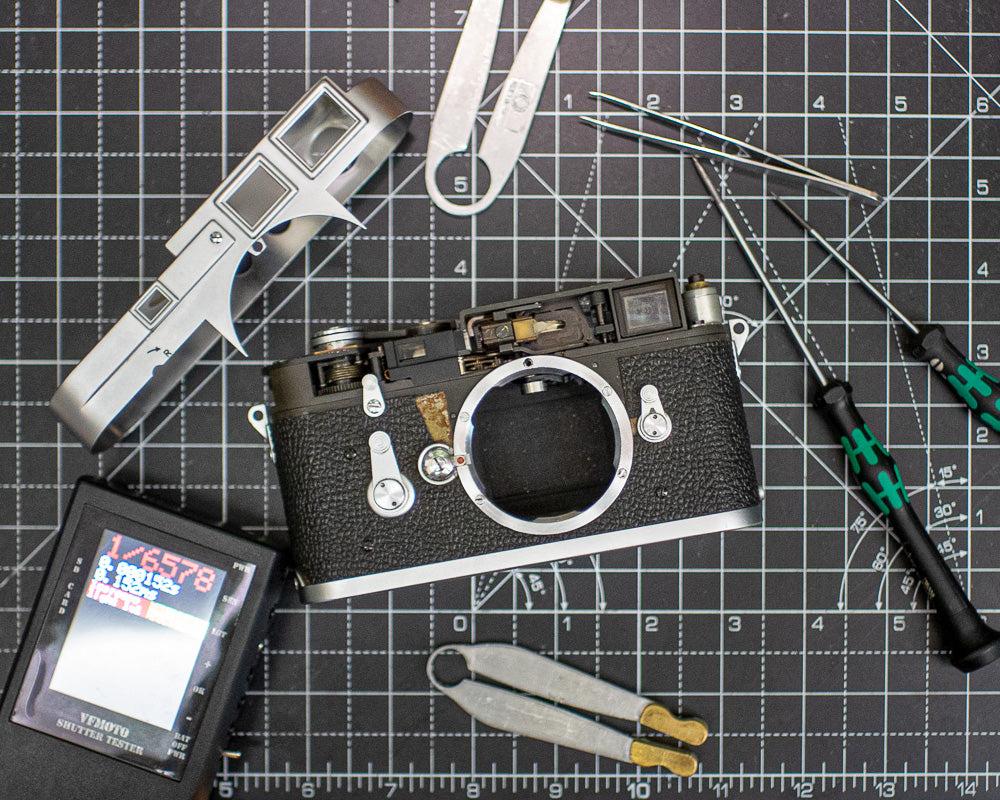
Shutter speed testing and tolerances.

Not sure if your shutter is working properly? If the slow speeds are sticking, or the fast speeds are capping then a service is needed. But how do you know if a repair was successful, and the shutter speeds are accurate? You might end up using a shutter speed tester, an audio app, or even just saying "One-Mississippi" and hoping for the best.


However carefully or diligently you might fettle and fine-tune a shutter mechanism, you'll never get the speeds to be exactly right down to the millisecond. That's where an acceptable tolerance comes in. Shutter speed timings that fall in this range can be deemed to be within specification.

Free Spreadsheet for Shutter Speed Testing.

I have created a Google Sheets table for you to fill in your own shutter speed testing results, and it'll automatically check your results against standardised tolerances.


Simply save a copy to your own Google Drive, and you can use it as many times as you like.


⭕ Google Drive Link

The following is based on the DIN 19015 Focal Plane Shutter Standards specification.

The desired shutter speed value is the Nominal Speed. This is the target fraction of a second. I have also included the millisecond value. The fractional values are generally standardised timings on most postwar camera models and shutters. You may find certain cameras have slightly different fractional shutter speed values e.g. 1/25th instead of 1/30th.

The following two millisecond values are the lower and upper tolerances for the measured speed. Provided your measured speed is within the upper and lower tolerances, you can consider your shutter speed to be accurate.

It's worth noting that leaf shutters, and other standards organisations have slightly different tolerance figures - but the DIN standard values below should get you close enough.

1/1 (1000ms)

  • Lower Tolerance 812ms
  • Upper Tolerance 1231ms

1/2 (500ms)

  • Lower Tolerance 406ms
  • Upper Tolerance 616ms

1/4 (250ms)

  • Lower Tolerance 203ms
  • Upper Tolerance 308ms

1/8 (125ms)

  • Lower Tolerance 102ms
  • Upper Tolerance 154ms

1/15 (66.7ms)

  • Lower Tolerance 50.8ms
  • Upper Tolerance 76.9ms

1/30 (33.3ms)

  • Lower Tolerance 25.4ms
  • Upper Tolerance 38.5ms

1/60 (16.7ms)

  • Lower Tolerance 12.7ms
  • Upper Tolerance 19.2ms

1/125 (8ms)

  • Lower Tolerance 6.35ms
  • Upper Tolerance 9.62ms

1/250 (4ms)

  • Lower Tolerance 2.86ms
  • Upper Tolerance 5.34ms

1/500 (2ms)

  • Lower Tolerance 1.43ms
  • Upper Tolerance 2.67ms

1/1000 (1ms)

  • Lower Tolerance 0.77ms
  • Upper Tolerance 1.33ms

1/2000 (0.5ms)

  • Lower Tolerance 0.38ms
  • Upper Tolerance 0.65ms

1/4000 (0.25ms)

  • Lower Tolerance 0.19ms
  • Upper Tolerance 0.33ms

Regrettably, this particular website does not allow text to be formatted into a table.

An Example:

The shutter speed on a camera is set to 1/125th of a second. If you divide 1 by 125, the perfect exposure time for this would be 8ms. The measured exposure time is - let's say 7.2ms - it would fall into an acceptable range of between 6.35 and 9.62ms on the chart above.


Another example - the shutter on a camera is set to 1/15th of a second. The perfect exposure time for this would be 66.7ms. The measured exposure time is 170ms - this falls far outside the acceptable range of 60.8 - 76.9ms and indicates a shutter issue.

Why do my shutter speeds need to be so accurate?

If a mechanical shutter is running too fast - or more commonly - too slow, then exposure will be incorrect and the resulting photos will come out brighter or darker than expected.

What is shutter capping?

Shutter 'capping' occurs when the two curtains of a focal plane shutter are moving too quickly or too slowly in relation to each other. It results in a dark, underexposed (or sometimes completely unexposed) area of the frame. This could be at the top or bottom of the frame in a vertically running shutter, or at the side of a frame in a horizontally running shutter.

What causes shutters to be inaccurate?

Most of the time, mechanical shutters become inaccurate or inoperative due to dried up lubricant through age or lack of use. These can usually be serviced and brought back to working order and within specification.

Sometimes, if it's an electronically controlled shutter, it can be caused by power issues or ageing electronic components.

Well, actually...

If you've spotted something not quite right in this article, feel free to drop me a message.

Shopping Cart

    Your cart is empty